
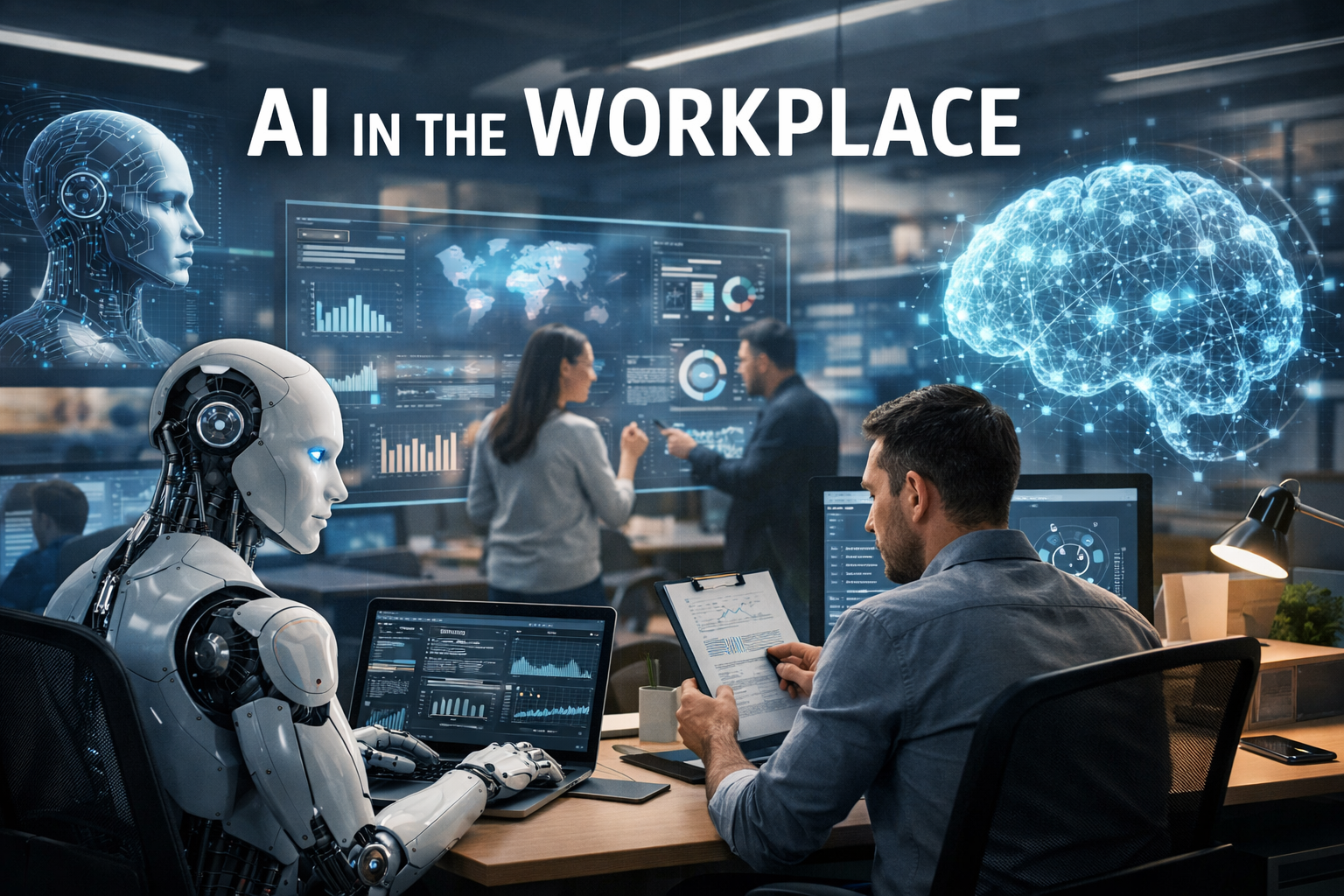
Discover how artificial intelligence is transforming the workplace, from automation to decision intelligence, and what it means for the future of work.
Artificial Intelligence (AI) is no longer experimental technology reserved for research labs. It has become a structural layer inside modern organizations — reshaping workflows, accelerating productivity, and redefining how professionals create value.
But despite widespread adoption, many companies misunderstand what AI in the workplace truly represents.
AI is not just automation.
It is not merely chatbots or content generators.
It is not a wholesale replacement for human labor.
Properly implemented, AI functions as cognitive infrastructure — an intelligent layer that augments decision-making, compresses operational timelines, and enhances organizational scalability.
This article explores how artificial intelligence is transforming the workplace, the benefits and risks involved, and how companies can strategically integrate AI for sustainable advantage.
What Is Artificial Intelligence in the Workplace?
Artificial intelligence in the workplace refers to the integration of machine learning systems, natural language models, predictive analytics, and intelligent automation tools into business processes.
Unlike traditional software, AI systems can:
- Analyze patterns in large datasets
- Generate structured outputs
- Make probabilistic predictions
- Adapt based on new information
- Assist with complex reasoning tasks
This marks a shift from simple task automation to cognitive augmentation.
How AI Is Transforming the Workplace
1. Automation of Repetitive Tasks
One of the most visible benefits of AI is automation.
AI-powered systems can handle:
- Data entry and validation
- Report generation
- Email sorting and summarization
- Scheduling coordination
- Basic customer service responses
This reduces manual workload and allows employees to focus on higher-value strategic tasks.
However, automation is only the entry point.
2. Augmented Decision-Making
Modern AI systems assist professionals by:
- Summarizing complex datasets
- Forecasting trends
- Identifying anomalies
- Recommending optimized actions
In finance, AI predicts cash flow patterns.
In marketing, it analyzes campaign performance.
In operations, it models supply chain risks.
This shifts professionals from data gatherers to decision supervisors.
3. AI in Marketing and Content Creation
Marketing departments are among the most transformed by AI.
Applications include:
- SEO topic modeling
- AI-assisted copywriting
- Audience segmentation
- Automated A/B testing
- Image and video generation
The result is increased content velocity without proportional increases in staffing.
The key is oversight. AI accelerates output — humans ensure strategic alignment.
4. AI in Software Development
AI coding assistants help developers:
- Generate boilerplate code
- Suggest optimizations
- Detect security vulnerabilities
- Accelerate debugging
This does not eliminate developers. It increases development throughput and reduces friction in execution cycles.
The value shifts from typing code to architecting scalable systems.
5. AI in Human Resources
HR departments leverage AI for:
- Resume parsing and candidate ranking
- Workforce analytics
- Attrition prediction
- Skills gap analysis
- Interview transcription
However, ethical governance is critical here due to potential bias risks.
Benefits of Artificial Intelligence in the Workplace
Organizations that integrate AI strategically experience:
Increased Productivity
AI reduces repetitive work and accelerates turnaround times.
Enhanced Accuracy
Machine learning models can detect anomalies and inconsistencies that humans might overlook.
Scalability
AI systems enable organizations to handle growth without linear increases in labor costs.
Faster Decision Cycles
Predictive analytics compress analysis time, enabling quicker execution.
Risks and Challenges of AI Integration
Despite its advantages, AI introduces structural risks.
Bias and Fairness
AI models trained on historical data may reproduce embedded biases.
Data Privacy Concerns
AI systems often require large datasets, raising compliance challenges.
Over-Reliance
Excessive dependency on AI may erode human critical thinking skills.
Governance Complexity
Organizations must define clear accountability for AI-generated outputs.
Without governance, AI can amplify inefficiency instead of solving it.
How to Implement AI in the Workplace Strategically
Successful AI adoption requires structured implementation.
Step 1: Identify High-Impact Use Cases
Focus on processes that are repetitive, data-heavy, or time-sensitive.
Step 2: Redesign Workflows
AI should not be layered onto broken systems. Redesign workflows to integrate automation intelligently.
Step 3: Establish Governance Policies
Define:
- Data usage standards
- Bias auditing procedures
- Transparency guidelines
- Output validation protocols
Step 4: Train Employees
AI literacy is essential. Teams must understand both capabilities and limitations.
The Future of AI in the Workplace
AI is evolving from supportive tools to semi-autonomous agents capable of executing multi-step workflows.
Emerging developments include:
- AI-powered decision support systems
- Intelligent internal knowledge assistants
- Autonomous workflow agents
- Predictive organizational modeling
The workplace of the future will be:
- Less repetitive
- More analytical
- More architecture-driven
- More collaborative between human and machine
Professionals who develop systems thinking, critical evaluation skills, and automation literacy will thrive.
Will AI Replace Jobs?
The more accurate question is:
Which tasks will AI replace?
Repetitive cognitive tasks are most vulnerable.
Strategic thinking, ethical judgment, creativity, and complex problem-solving remain human-dominant domains.
Historically, technological revolutions create new roles while transforming existing ones.
AI is no exception.
Final Thoughts: AI as Organizational Infrastructure
Artificial intelligence in the workplace is not a temporary trend.
It represents a structural shift in how organizations operate.
Companies that treat AI as a novelty feature will struggle.
Companies that integrate AI as core infrastructure will gain long-term competitive advantage.
The real differentiator is not tool adoption — it is architectural discipline.
When implemented strategically, AI becomes a force multiplier — increasing precision, speed, and organizational intelligence.




Leave a Reply